
Knowledge Article
LEED v5: Reducing Embodied Carbon and the New Credit System for EPDs
Introduced by the US Green Building Council in 1998, LEED (Leadership in Energy and Environmental Design) is the most widely used green building rating system in the world, providing a framework for creating healthy, highly efficient, cost-saving green buildings.
Major Updates in LEED v5
New scoring system
LEED v5’s revamped scoring system reflects its primary goals. Half of the available points in v5 will relate to climate action, while the other half are equally split between quality of life and ecological initiatives. One of the standout changes in LEED v5 is the separation of energy efficiency and carbon emissions into distinct credits, making it easier for projects to earn points for energy efficiency without the need for complex simulations. Achieving Platinum certification now requires exceptional energy efficiency and electrification as well as meeting separate decarbonisation thresholds.
Materials and resources
The focus on embodied carbon has increased significantly in LEED v5. It introduces a new credit concept focused explicitly on procuring low-carbon construction materials as part of the broader effort to reduce the embodied carbon footprint associated with building materials.
These new LEC credits address the carbon footprint of materials and construction processes, including tracking job-site emissions and choosing materials with lower embodied carbon. This shift highlights the importance of considering the entire lifecycle of building materials through Lifecycle Environmental Criteria. LEED v5’s incorporation of Lifecycle Environmental Criteria as part of its comprehensive approach to sustainable building practices involves evaluating a building’s environmental impact from construction and operation to final demolition or reuse, so that projects not only meet immediate environmental goals but also consider long-term ecological effects.
The key aspects of this credit are:
- Focus on carbon-intensive materials: The credit targets materials with high carbon footprints, such as concrete, steel, aluminium, and other carbon-intensive materials, to significantly lower the overall embodied carbon in construction projects.
Simplified options: The new credit offers three options to earn points:
- Option 1: whole-building lifecycle assessment (LCA): This option requires a comprehensive assessment of the building’s lifecycle to identify and reduce embodied carbon.
- Option 2: low-carbon procurement: This simplified option focuses on procuring specific low-carbon materials. By reducing complexity and focusing on high-impact materials, it aims to be more accessible and straightforward than previous versions.
- Option 3: Environmental Product Declarations (EPDs): This option involves using materials with verified EPDs, emphasising transparency and environmental performance.
- Inclusion of job-site emissions: For the first time, LEED v5 includes job-site carbon emissions as part of the embodied carbon assessment. As a result, tracking and mitigating emissions from construction activities are now integral to earning this credit.
- Alignment with sustainability goals and legal requirements: While LEED v5’s ‘Buy Clean’ requirements are specifically tied to US legislation, the concept of prioritising low-carbon construction materials is increasingly being adopted internationally through different legislative and regulatory frameworks. Including embodied carbon reduction aligns LEED v5 with international sustainability goals, including those outlined in the Paris Agreement.
By incorporating these elements, LEED v5’s low-carbon procurement credit aims to significantly reduce the carbon footprint of new construction and major renovations, promoting sustainability from the ground up.
Integration of EPDs with materials and resources credits
As mentioned above, Environmental Product Declarations (EPDs) play a significant role in LEED v5, integrating into the materials and resources credits to promote transparency and sustainability in building materials. EPDs fit into the new LEED v5 framework in the following ways:
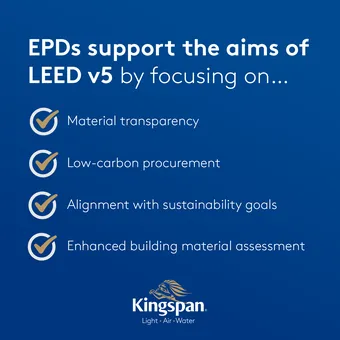
- Material transparency: EPDs provide detailed information about products’ environmental impacts, including data on resource use, emissions and other ecological impacts. By requiring or encouraging the use of materials with EPDs, LEED v5 promotes transparency and informed decision-making in material selection.
- Low-carbon procurement credit: EPDs are a critical component of the new low-carbon procurement credit, as one option to earn points involves using materials with verified EPDs. This emphasises the importance of choosing materials with documented environmental performance so project teams can lower buildings’ embodied carbon.
- Alignment with sustainability goals: EPDs support LEED v5's overall sustainability goals by providing standardised information to compare and select materials based on their environmental impacts. This alignment helps projects meet climate action, quality of life and ecological conservation goals.
- Enhanced building material assessment: Including EPDs in LEED v5 enhances building materials’ assessment beyond their immediate environmental impacts. It allows for a more comprehensive evaluation of their lifecycle impacts, promoting the use of products that contribute to lower overall carbon footprints and better environmental outcomes.
Other notable changes in LEED v5 include:
Resilience and health
LEED v5 strongly emphasises climate resilience and social equity. New prerequisites include climate resilience, social impact assessments and operational carbon projections to ensure that projects are environmentally sustainable and socially responsible. Equity considerations are embedded throughout LEED v5’s entire rating system, rather than being standalone points. Interweaving equity metrics into various credits and categories puts social equity in the spotlight as a fundamental aspect of sustainable building practices.
Innovation and simplification
LEED v5 simplifies some of its previous versions’ more complex and costly aspects, making the system more accessible. Changes include offering prescriptive paths for certain credits and reducing the need for intricate calculations. These changes empower architects and building owners, making sustainable building practices achievable for a broader range of projects.
Structural changes
LEED v5 encourages integrative planning and processes among project teams starting at the early stages of design and construction. This collaborative approach fosters better outcomes and ensures that sustainability is considered at every project stage.
Conclusion
LEED v5 represents a significant step forward in sustainable building certification, ensuring that green building practices are more inclusive, effective and impactful by addressing key areas such as decarbonisation, resilience, equity and materials. With simplified pathways for achieving Material credits, including options for using Environmental Product Declarations (EPDs) and selecting materials with verified lower carbon footprints, LEED v5 will offer reduced complexity and enhanced accessibility. As a manufacturer, we welcome LEED v5 as a driver that will encourage further innovation in material production to develop lower embodied carbon materials and foster transparency in the supply chain.
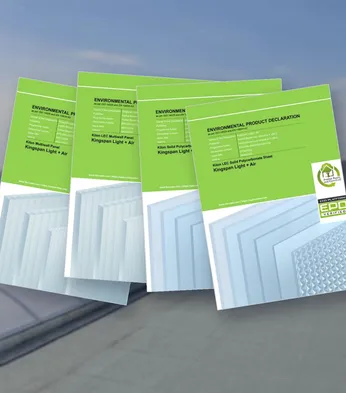
Kingspan Light, Air + Water (KLAW) is committed to supporting architects and building owners in achieving and demonstrating high levels of sustainability through the LEED standard. We are committed to addressing the embodied carbon of our products and materials. Discover how our approach worked in action with the development of lower embodied carbon product KILON LEC Multiwall Sheet
Kingspan Light, Air + Water
Talk to Our Team
Our team is available to support you from first enquiry through to completion.