
Knowledge Article
The Importance of Material Circularity in Construction Products
Circularity is not only a key trend in the construction products sector, but a vital business decision that is key to both reducing the impact that creating and maintaining our built environment is having on our planet and to ensuring a sustainable economic model far into the future. In this article, we explore what circularity is and how we at Kingspan are working to contribute to circular buildings.
What is circularity?
Our current economy is based on the linear idea that we take raw materials from the Earth, manufacture products from them, sell and use them and then, at the end of their useful life, they are disposed of. This linear system has obvious environmental costs, from depleting natural resources to polluting landfills with waste products.
An alternative approach is a circular economy, which seeks to keep materials in useful circulation for as long as possible. In a circular economy, products and materials are kept in circulation through processes like maintenance, reuse, refurbishment, remanufacture, recycling, and composting. In addition to protecting the planet, adopting circularity is also more economically resilient. Rather than relying on finite resources, it sets up a system of consumerism which is more sustainable over longer periods of time.
Circularity is especially important in the global construction sector. According to the World Green Building Council, “the built environment is responsible for half of global resource use and even if we fully decarbonise tomorrow, we will only remove 55% of the source of GHG emissions. The other 45% comes from the production and consumption of resources and materials.” What’s more, construction accounts for a third of the world’s waste. Adopting a more circular approach to how we produce and manage construction materials and products could help us to create a more sustainable industry.
How is Kingspan Group addressing product circularity?
Delivering circularity at scale needs businesses to take a holistic approach, looking not only at product design and innovation but also policy change and transformed waste initiatives. Across our product portfolios, we are committed to taking a full product lifecycle approach and finding new ways to collaborate to deliver systematic changes in both our business and the wider industry.
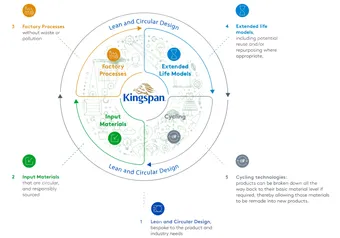
Collectively, we have developed a LIFECycle Product Circularity Framework which looks at Lean and Circular design, Input Materials, Factory Processes, Extended Life Models and— importantly for this article— Cycling.
This framework is helping us to develop product roadmaps, from design for disassembly through to end-of-life recycling, and to spot and seize opportunities to improve circularity and tackle the embodied carbon associated with our products— as exemplified by the development of KILON LEC Multiwall.
The potential of polycarbonate
Polycarbonate has long been identified as a key material in the journey to circularity. The thermoplastic polymer is known for its high impact resistance and has proven usefulness in a whole range of applications, from fighter jet windows to safety goggles. Its strength and versatility have also been embraced in the architectural world, where its translucency, durability and thermal performance lends itself well to all kinds of daylighting solutions — including curtain walling and wall light panels.
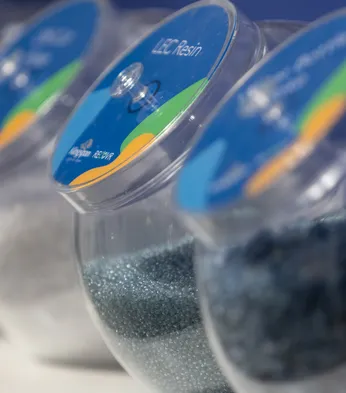
Whatever application it is used for, at the end of the product lifecycle, polycarbonate can be collected, processed and recycled into new materials with no loss of quality. This closes the supply loop, reducing the demand for raw materials and the amount of waste going to landfill. As a producer of polycarbonate daylighting products, we have been exploring how these properties can help us develop a more circular supply chain and create products with lower embodied carbon (LEC), such as our recently launched KILON LEC Multiwall sheets
Circularity in action – the KILON LEC Multiwall example
Using the Kingspan LIFECycle Product Circularity Framework, we can see how KILON LEC Multiwall has been developed to embrace circular economy principles:
Input Materials
KILON LEC Multiwall incorporates 50% post-consumer recycled (PCR) polycarbonate from large blue water dispenser bottles, and we are exploring options to increase this in the future.
Factory Processes
KILON LEC Multiwall is manufactured at our Daylighting Centre of Excellence (DCOE) which carries both ISO 9001 and ISO 14001 standards, demonstrating a commitment to environmental responsibility and quality management.
Extended Life Models
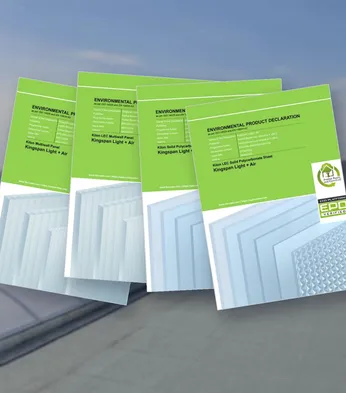
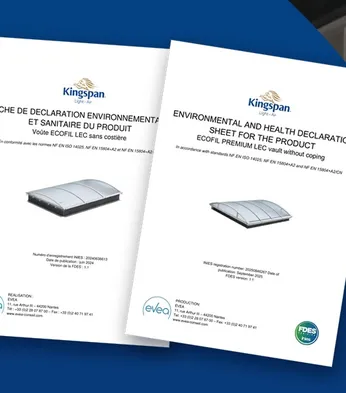
As a material, polycarbonate is less vulnerable to UV degradation meaning it can continue to provide excellent light transmission for decades, without yellowing. Additionally, the product has gone through extensive quality testing and ongoing sampling of materials to ensure a long useable life. It has been tested under the relevant European Standards to make sure it is fully compliant, with assurance from third-party independent certification and performance declaration. We have also designed the product with fixings which allow for simple disassembly at the end of a building’s life.
Cycling
The polycarbonate is fully recyclable at end of life and can be remanufactured to create a range of new products with no loss of material quality.
Kingspan Light, Air + Water
Talk to Our Team
Our team is available to support you from first enquiry through to completion.